Ozzy Osbourne: How Black Sabbath's oddball Brummie pioneered a new genre
As the Black Sabbath ballet head(bang)s our way, Greg Thomas reflects on the band’s hellraising frontman
It’s extraordinary, funny and strangely pleasing to imagine the technical virtuosity and androgynous beauty of the Birmingham Royal Ballet troupe being poured into the story of four drug-addled working-class boys from Aston who conquered the world with lumbering, deeply masculine music about Satan and cocaine.
Black Sabbath’s frontman Ozzy Osbourne, who died in July, was both the epitome of the group and on the fringes, even within this gaggle of outsiders. Legend has it that prior to joining Sabbath he could be seen walking around the neighbourhood with a shaved head and a hot-water tap round his neck, barefoot but dragging a trainer along on a dog lead.
Whereas band leader and tough guy Tony Iommi, and sensitive lyricist Geezer Butler were attached to the souring late-60s hippy culture, Osbourne was genuinely weird. Some of his outlandish behaviour might have had to do with processing trauma: he was sexually abused as a pre-teen and attempted suicide as an adolescent.
Indeed, throughout his life, Ozzy’s persona seemed shaped at some level by low self-esteem, an odd thing to say given his career. Ultimately it was the resultant quality of fragility that made him so appealing. For a metal frontman, he was remarkably devoid of ego. Ok, he was caught up in the gross indulgences of 70s rock stardom, but his stage charisma had to do with a simple, master-of-ceremonies type rabblerousing rather than crotch-thrusting narcissism. Off stage, he was a clown, constantly making a fool of himself for a laugh in that way in which people seeking acceptance out of insecurity often are.
Osbourne was famously fired from Black Sabbath in 1979 after his addictions made him impossible to work with. He found himself a solo artist at the birth of the glam-metal explosion, when cynical and grotty bands like Kiss and Mötley Crüe were busy turning heavy guitar music from something about catharsis and outsider-ness into a kind of predatory peacocking.
Ozzy toured with Mötley Crüe but was never one for boasting about the size of his hareem. He was still the weird kid from Birmingham, making a spectacle of himself to fit in. When the glam coterie fell out of favour in the early 90s, Black Sabbath and Ozzy’s influence survived. Indeed, they were seized on as foundation stones for the far more interesting and enduring grunge movement.
An oddball caught up in a whirlwind of success generated by the more gifted musicians around him, in a way Osbourne always seemed thrust into the spotlight by chance. So it made sense when he became a reality TV star with The Osbournes (2002–05). While it might seem off-colour to remember him for the unwittingly, and wittingly, hilarious antics of these years (falling asleep with the blender on, mangling a performance of ‘Take Me Out To The Ball Game’ at a Chicago Cubs game), it was all of a piece with the persona he’d expressed over decades. More of a comic talent than a musical one; charming, ludicrous, and deeply, deeply loveable.
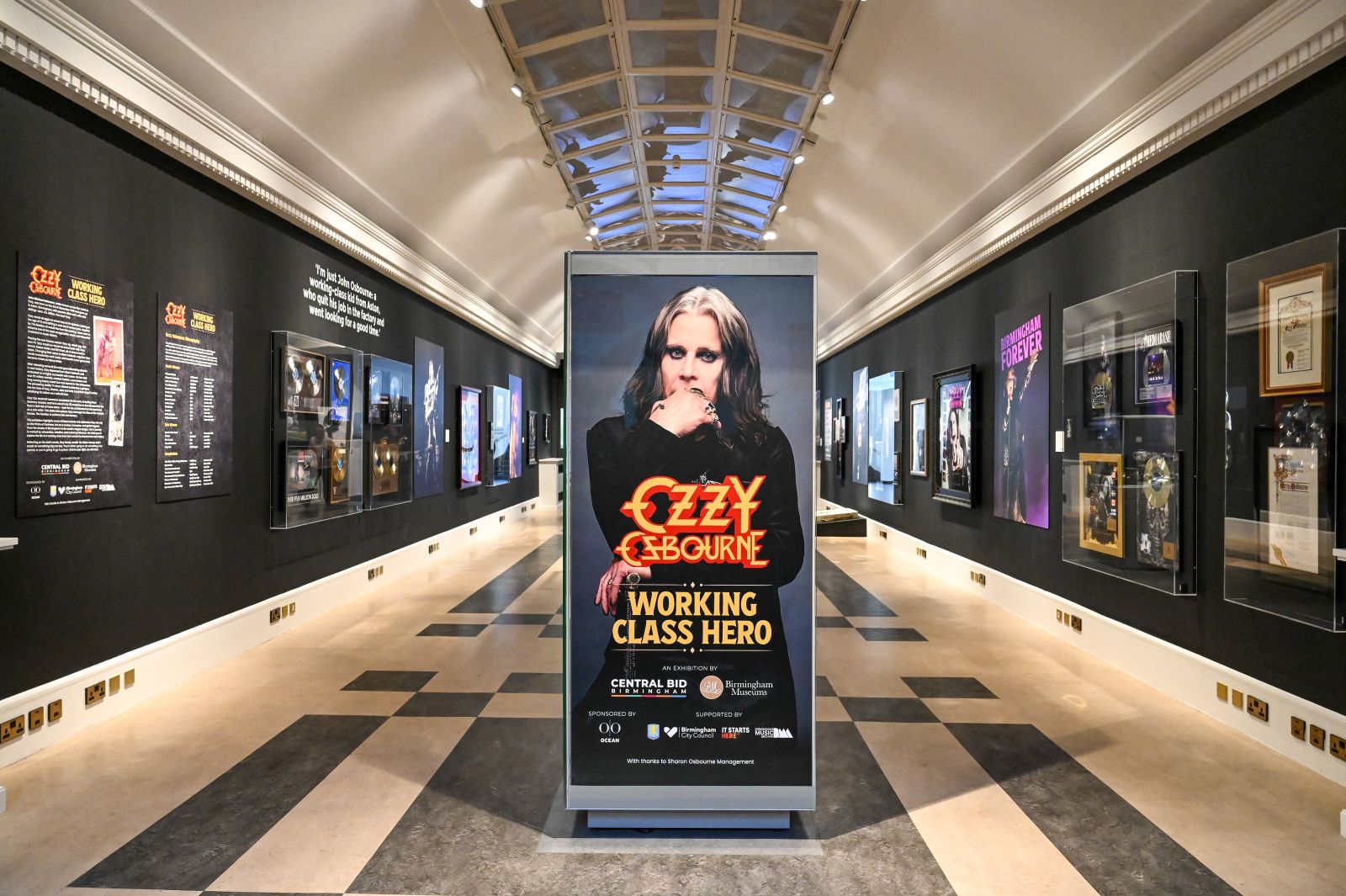
Image supplied by kind permission of Birmingham Museums Trust whose exhibition Ozzy Osbourne: Working Class Hero runs until Sunday 18 January.