Director Hu Yaguang on The Landscape Of The Other Shore: 'I was hit by something real, something visceral'
We spoke with director Hu Yaguang about the origins of this piece, the collaborative process behind it, and the long journey from Shenzhen to Edinburgh
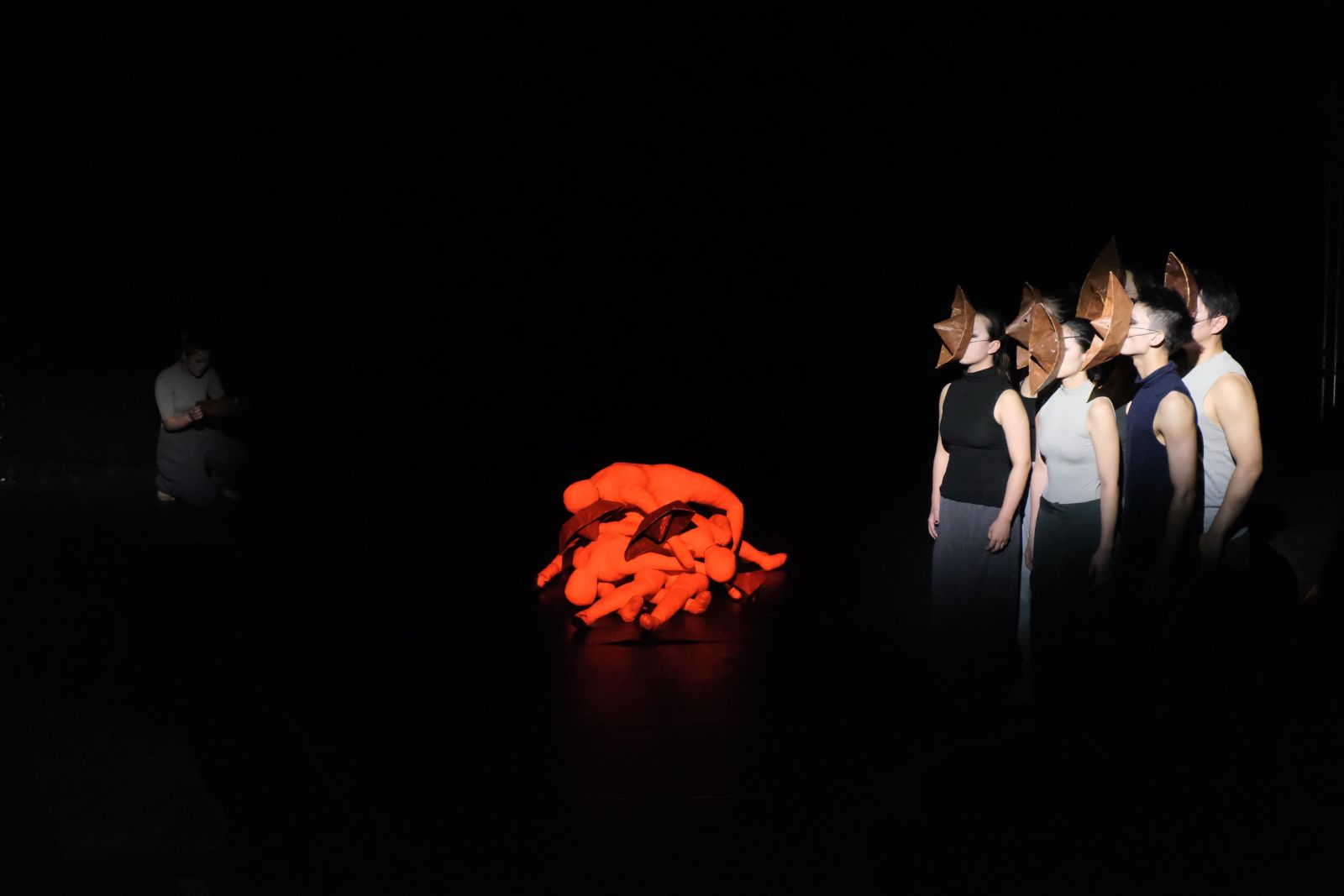
At this year’s Edinburgh Festival Fringe, The Landscape Of The Other Shore unfolded as a haunting parable of human nature, told through minimalist movement, shadow, and projection. Created by the 201 Theatre Company from the School Of Arts at Shenzhen University, the production draws inspiration from Giorgio de Chirico’s painting The Raft Of The Medusa and the expressionist play of the same name by Georg Kaiser. The work strips away gender, nationality and identity, asking: when everything is removed, what remains of a person? We spoke with director Hu Yaguang about the origins of this piece, the collaborative process behind it, and the long journey from Shenzhen to Edinburgh.
Could you briefly introduce The Landscape Of The Other Shore in a few sentences?
The Landscape Of The Other Shore is a classic reinterpretation. We began with Giorgio de Chirico’s painting The Raft Of The Medusa, combined it with Georg Kaiser’s expressionist play of the same name, and then slowly shaped it through a devising process and performance workshops. Although the piece appears dark on the surface, what we’re really trying to explore is this: after going through the darkness of human nature, is it still possible to find a bit of light, or a sense of hope?
Can you tell us about the initial inspiration for this production?
I came across a German edition of Kaiser’s play in a second-hand bookstore overseas. He had adapted the real-life event by turning the adult characters into children, which made it more brutal, more piercing. From that moment, I knew I wanted to stage that painting. In my mind, I kept seeing these ‘frames’, visual frames. I wanted the audience to look exactly where I asked them to look. That’s why the piece uses a lot of mirrors, multimedia, and projection. Sometimes it's a frame, sometimes it's a painting, sometimes it reflects back on yourself. At the farthest edge of Chirico’s painting, there’s a tiny boat. I believe he wanted to offer, amidst catastrophe, a small gesture of release. So I turned that boat into a kind of mask. A mask of hope. We use that ‘hope’ to erase every external label of the characters: gender, nationality, ethnicity, identity, they don’t matter. What remains is simply ‘a person.’ Just a human being, with nothing else.
What was the creative process like with your performers?
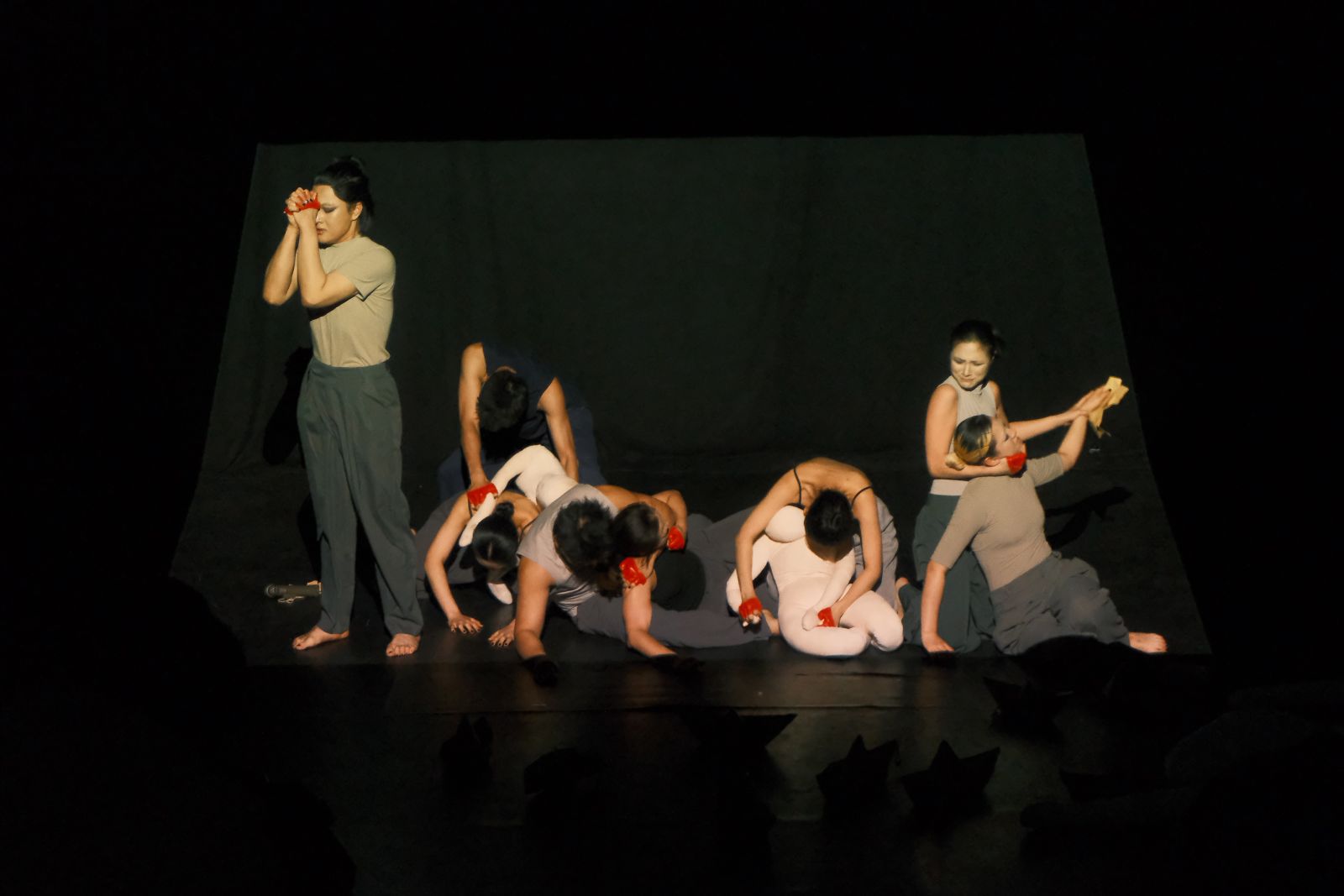
I set the direction from the start; this was going to be The Raft Of The Medusa. But from there, it became a collaborative process: researching real-life stories, doing physical exercises, and building the structure together. Every small segment in the show is based on a real news story. Every day, we were reading articles, collecting materials, and discussing. I didn’t want to make up a dark story out of imagination, we weren’t interested in judging good versus evil. What we really wanted to ask was: what is human nature capable of? I kept asking my performers: is the potential to become ‘evil’ already inside us? Where’s the tipping point? We talked a lot about the ‘Lucifer Effect’, how someone becomes a monster, how someone falls from grace. The entire piece is us getting closer to that question. We built this work with a clear internal compass. I knew exactly where it needed to go, and when to pull it back. It couldn’t afford to lose focus. As for the cast, they’re young, but far from inexperienced. Many have already worked with major directors. Two of them were the Chinese performers in Hamletmachine, the final production Robert Wilson directed before he passed. Another was selected for Suzuki Tadashi’s training camp and will be performing in Japan before returning to China for the Wuzhen Theatre Festival. I used to teach students how to build characters. But after I started directing, I realised I needed to express my own voice, my stance, my thoughts, through the work. One of my mentors once told me, ‘In the 21st century, the places people need most are churches and theatres.’ I’ve always believed that. The theatre is where I place my soul.
What were some unexpected challenges in bringing the piece from Shenzhen to Edinburgh?
Too many to count. Shenzhen University has been very supportive throughout, but when you’re touring internationally, nothing is simple; visas, logistics, tech coordination, every step takes real effort. But in the end, the question was, are we going to do it or not? And our answer was always, let’s do it. Let’s just go for it. Over the past six months, we’ve been fully focused on this work, refining it after every showing. From domestic runs to the Shanghai Theatre Academy, to the Daliangshan International Theatre Festival, and now here in Edinburgh. Not every version was perfect. But we kept distilling, cutting, compressing, until we found this version. Some things had to be sacrificed, certain staging elements, some theatricality. But I don’t regret it. This was never meant to be a ‘fixed’ performance. It’s something that should grow in different spaces, different terrains. Whether we’re on home ground or abroad, as long as we’re expressing the core of the work, that’s enough.
What’s your impression of Edinburgh so far?
I’ve seen a few shows, and what struck me is that so many artists are creating work from their own lives. They’re not just performing a script – they’re performing themselves. And I love that. Every person who comes here has a different reason. Why are they telling these stories? Why are they choosing to tell them this way? That question really fascinates me. It pulls me in. At the same time, I’m also very curious about how Western audiences, especially those from different cultural backgrounds, see us. We’re a group of young artists from Shenzhen, which isn’t what most people would call a ‘culturally rich’ city. It’s a new, immigrant city. But that’s exactly where we’re from. That’s what shaped us. And I want to know how people respond to that perspective.
What are your plans for future work? Could this piece have a ‘sister production’?
Right now, I’m waiting for a Chinese painting. Not any specific one, but one that makes me fall into it, the way The Raft Of The Medusa did. You know, when Chirico painted that work, he literally brought corpses into his studio. He watched them rot, watched the colours change, watched their bodies decay. He didn’t rely on imagination, he put himself into it. That’s why we fall into it too. Because he went all in. That’s what happened to me with this piece. I was hit by something real, something visceral. So now, I’m waiting for a painting from China that hits me the same way. I’ve looked at many, Along The River During The Qingming Festival, The Skeleton Illusion Scroll, but none of them have truly struck me yet.
I’m looking for that one image that pulls me in, that makes me need to make a new piece. If I find it, I may combine it with Chinese calligraphy, poetry, or even opera. This time, we responded to a Western painting. Next time, I want it to be Chinese, something born from our own cultural context. I grew up in a traditional theatre family. My father was a Chinese opera performer. I was raised backstage, around music and movement. For my graduation piece, I directed Mulan and used many traditional opera forms. But what I want now is to take those traditional forms, their stylisation, their abstraction, and merge them with contemporary theatre. With technology, language and space. Whether or not it’s a direct ‘sequel’ to The Landscape Of The Other Shore… I don’t know. But I do know it won’t be far away.
The Landscape Of The Other Shore, C Aurora, run ended.
This is a sponsored post written on behalf of EggGen.