Richard Strachan on his novel Night Fire: 'War is an arena in which people demonstrate their best and worst qualities'
Drawn to the darker side of human nature with his writing, Richard Strachan launches the latest of his war novels. He tells Lucy Ribchester that the notion of historical fiction being a cosy genre is painfully false
%20Polly%20Markham.jpg)
It’s a coincidence that the day we speak to Richard Strachan about his new World War II-set novel is the four-year anniversary of the start of Russia’s war in Ukraine and just a few days prior to the raging conflict in Iran. But this is not a detail that has passed Strachan by. ‘This is, I think, an era of war, as it always has been, but it seems much more dominant now than it’s been since the end of the Second World War.’ Conflicts have always been a strong interest of Strachan’s. He studied history at the University Of Glasgow, followed by a masters in battlefield archaeology. Combined with the visibility of the war in Ukraine (‘people used to go there on stag weekends’), he was prompted to embark on writing a trilogy of novels set during World Wars I and II, the second of which is Night Fire.
‘War is an arena in which people demonstrate their best and worst qualities,’ Strachan says. ‘It’s also something that is a human constant. It goes back to the beginning of any kind of human civilisation. I think often people like to turn their face away from that and have a slightly rosier view of human nature. I think I have a slightly darker view.’
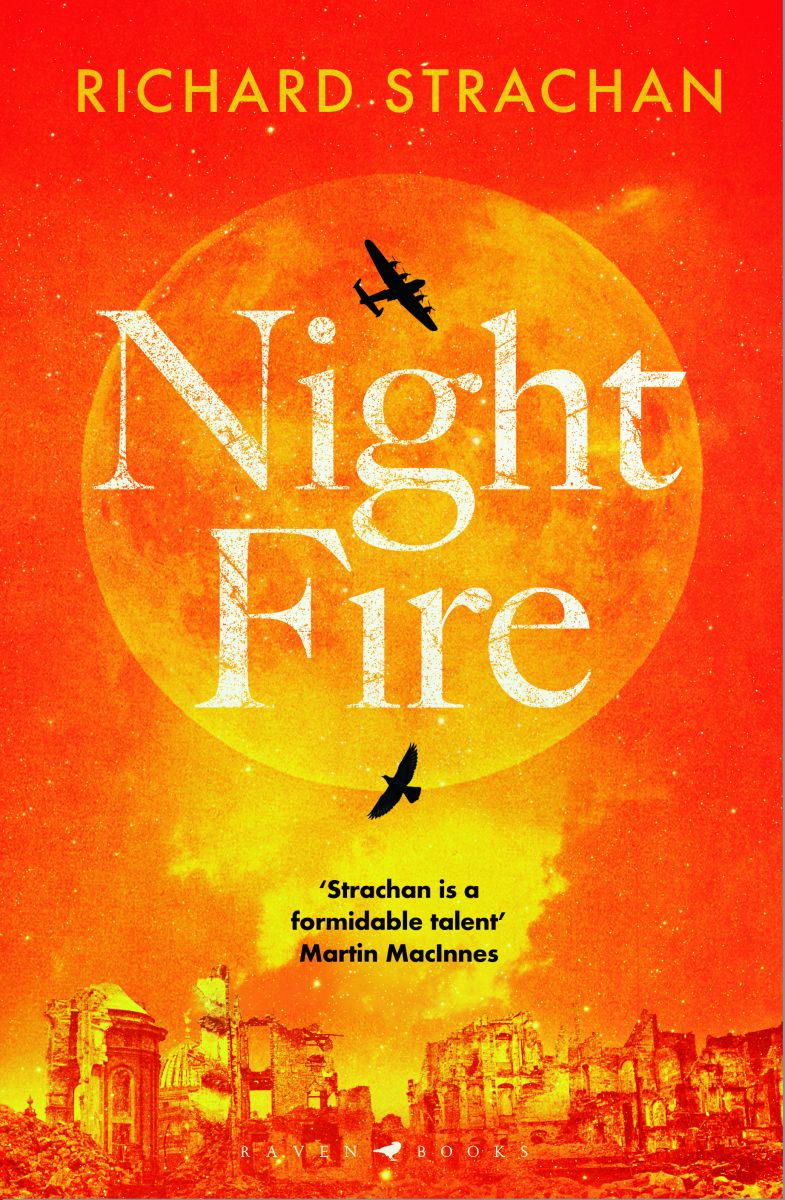
Darkness is certainly the dominant mood music in Night Fire. It’s a haunting novel in two ways: with ghosts that stalk each of its protagonists as well as in its lyrical, poetic writing where beauty and pain frequently intertwine. The story follows the revolving fortunes of an ensemble of young, bright RAF men undertaking their obligatory 30 missions in a Lancaster bomber before being relieved of duty. Counterpoint to this is the story of aircraft repair engineer Abigail Sallow, an exquisitely drawn character, processing her own wartime grief.
To tread the careful tightrope act of recreating the past, Strachan consulted wartime memoirs, YouTube videos on airplane models and technical books (‘there are lots of books written by nerdy men who like machines,’ he says). But ultimately, Strachan believes writers should be beholden only to the stories that interest them. ‘I am wary about any subject being judged on its relevance or not. It is just really whether it interests the writer and hopefully this interests a reader.’ Strachan rejects the frequent claim that historical fiction is somehow cosy. ‘The smallest, most cursory glance at history will show you there’s very little in it that’s comforting or cosy. Quite a lot of it is actually horrific.’
Night Fire is published by Raven Books on Thursday 23 April; Richard Strachan will be in conversation with Lucy Ribchester at Blackwells, Edinburgh, on that day; main picture: Polly Markham.