Rise Festival dance round-up: Challenging and thought-provoking
A weekend of performances, workshops and podcast interviews in a dramatic setting introduced audiences to vital and often unheard voices
How fitting that a place of such natural beauty should focus an entire festival on the concept of land. Findhorn peninsula holds so much history in its lush forests, vast dunes, beautiful beaches and large bodies of water. But it’s also known worldwide for its forward-thinking attitude and warm welcome. Run by Dance North in one form or another since 2014, the Rise Festival is absolutely rooted in its surroundings yet is increasingly outward looking.
Over the final weekend of May, this year’s theme of ‘Global Indigenous Voices’ took this approach to a whole new level, and attendees were all the richer for it. Choreographers from Canada, Australia, New Zealand and the United States travelled to this small pocket of Scotland to share their artistry and heritage. Whether they were delivering performances, hosting participatory workshops or taking part in podcast interviews, Lara Kramer, Daina Ashbee, Gary Lang, Jacob Boehme, Barbara Diabo and Martha Hincapié Charry (all of whom descend from indigenous ancestry) offered us a chance to see things differently.
If you’re born in a country that has colonised others, denied cultures, and demanded names and languages be changed, it can be hard to know what to do with the feelings of historical shame this bestows. Listening to and learning from those affected by it is, of course, a great place to start. During the Friday afternoon workshop We Are The Land, Barbara Diabo stood centre-stage in her traditional Mohawk clothing, performed an incredible storytelling hoop dance (shaping the hoops into everything from a cradled baby to a boat with oars) then taught us a brief segment of music and movement she had ‘permission’ to share with us. The notion that some indigenous songs and dances are not allowed to be shared outside the tribe will have been news to many (including me) and was just one fascinating element of this multi-faceted weekend.
Exchanges such as this make Rise so special. Workshops are open to all, regardless of dance interest or experience, and are precious moments to pause, reflect, learn from others and leave somehow changed. This year’s shows (often more performance art than dance) may not have recruited many newcomers to the contemporary dance fold but always gave us food for thought. And, if you stuck around, they became part of a holistic whole.
%20taking%20part%20in%20Dance%20North%20Conversations%20-%20credit%20Alexander%20Williamson.jpg)
For example, Lara Kramer (raised in Ontario of mixed Oji-Cree and settler heritage) performed two shows, ran a workshop and was interviewed for the Dance North Conversations podcast. Her Friday night solo, ‘Gorgeous Tongue’, was a tough watch for various reasons. A slow burner, with little opportunity to see Kramer’s face, the piece was filled with narrative prompts (items of clothing, multiple props) but the storytelling was so opaque that it felt hard to connect. The following day, her two-hour outdoor piece, ‘This Is The Place Where We Pray’, also challenged the audience’s endurance. Taking place in the car park of Moray Art Centre, Kramer spent over half the time washing the gravel-strewn ground. While some observers lost patience waiting for the show to ‘start’, there was something meditative about this ritual cleaning that was quietly compelling. With little to keep the mind entertained, thoughts have a chance to bubble up, such as who does the dirty work in our society? What fuels the commitment behind personal prayer and its preparation? The frustrating futility of cleaning a car park which will once again become marked with muck and oil from vehicles is an environmental metaphor if ever there was one.
Is it arrogant for a performer to ask people to sit for two hours and watch a car park floor being cleaned (followed by interludes of Kramer rolling on the ground in sodden clothes, then speaking quietly to a couple of audience members, inaudible to the rest of us)? Maybe so. But the joy of Rise is you could also take part in a delightful workshop run by Kramer and hear her discuss her work at a podcast recording. Pooled together, these close choreographic encounters have unquestionable merit.
We also had the privilege of hearing Daina Ashbee speak about her installation performance ‘Serpentine’ before watching it on Saturday night. Another slow, repetitive work, this would have benefited from allowing the audience to move around and observe it from several angles (as they did at Glasgow’s Tramway a week later). But regardless, Ashbee’s powerful body crawling snake-like across space, her oiled, naked skin glistening with both strength and vulnerability, was a portrait of resilience.
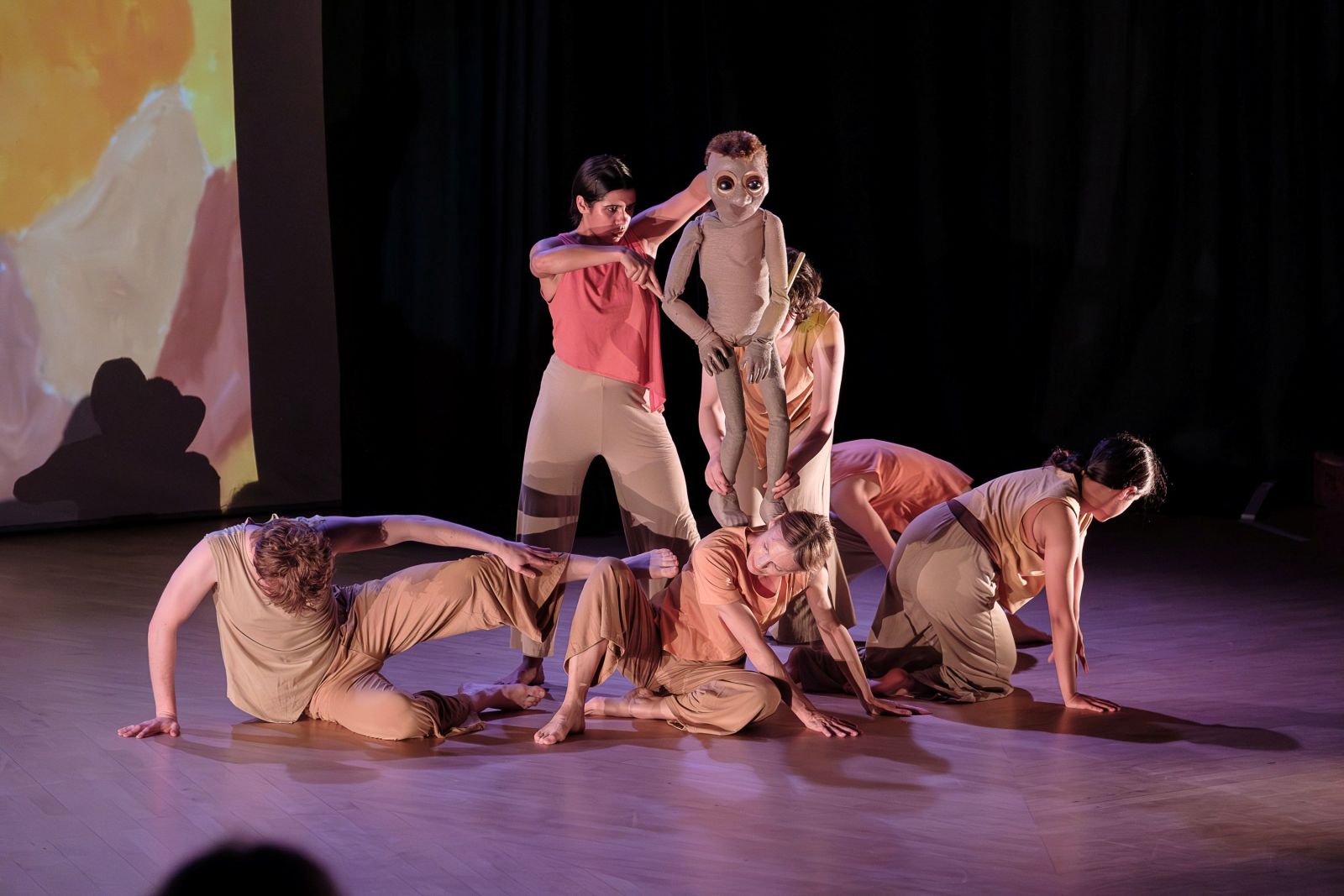
Finally, Jacob Boehme’s ‘Guuranda X’ (main picture) was a joyful coming together of indigenous Australian and Scottish dancers, a local choir and live musicians. Performed inside the Universal Hall and in the beautiful surrounding grounds, the piece fused storytelling (both local and global), dance, music, song and puppetry. A celebration of mutual respect, shared cultures (without appropriation) and human connection, it summed up the entire festival.
Rise Festival took place at The Park Ecovillage in Findhorn; pictures.