Wael Shawky art preview: Thought-provoking multimedia exhibition
Egyptian artist Wael Shawky’s new exhibition looks through a Middle-Eastern lens to revisit the centuries-long religious wars known as the Crusades. Neil Cooper hails Shawky’s artistry in challenging received western orthodoxies and acknowledges the relevance of his message as conflict continues to scar the region
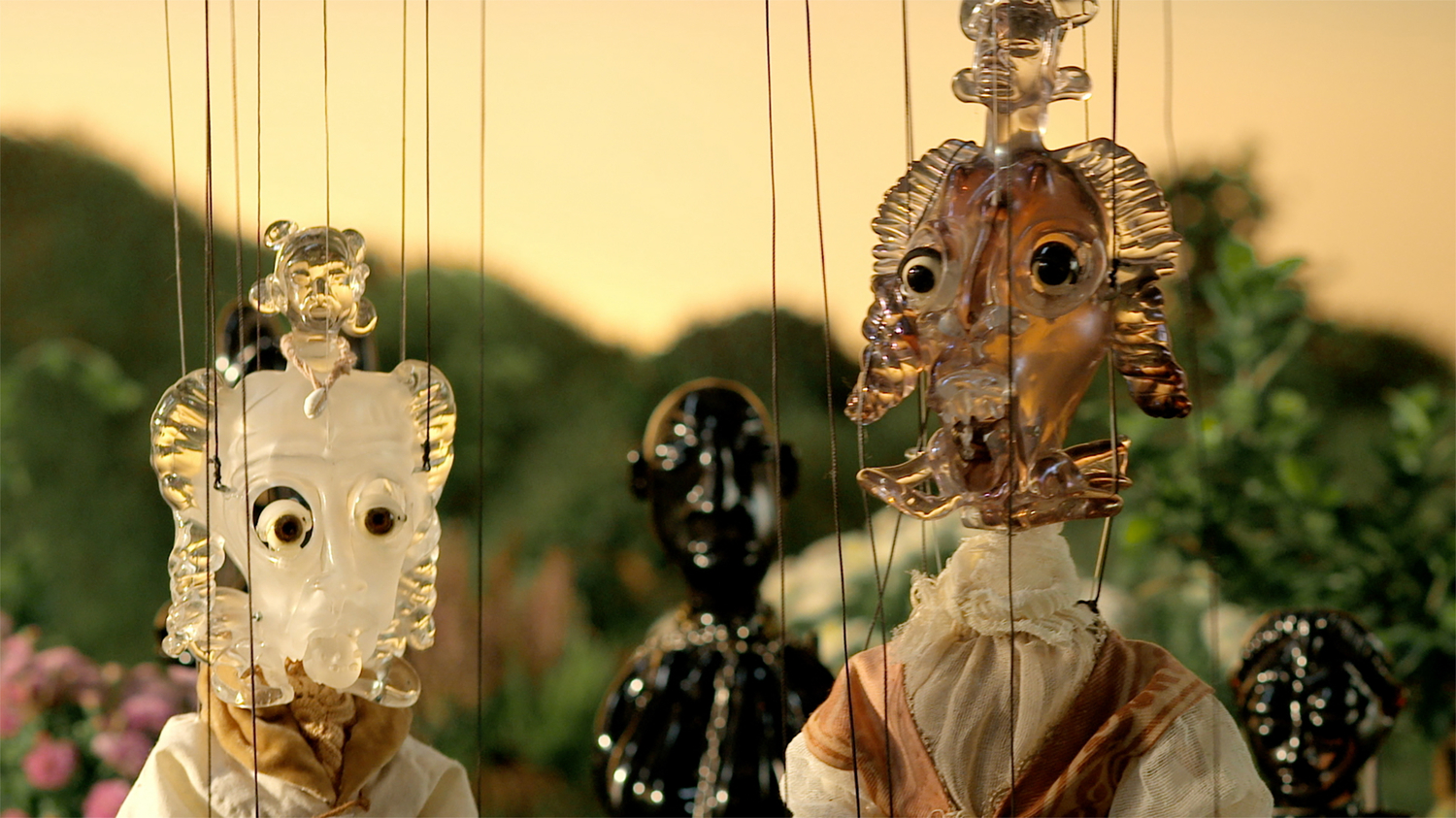
The cast of one of the two films that make up this large-scale exhibition by Wael Shawky are all lined up in a room. They are gathered together in full costume next to the gallery where the movie they appear in (the third part of a major trilogy) is screening on a loop. This is no red-carpet, Hollywood A-lister meet-and-greet, mind you. These actors are made of glass, fantastical marionettes that have their strings pulled by Shawky and many others to play out several hundred years of world-changing history.
Some of Shawky’s creatures look like they might have been dreamt up by master animator Ray Harryhausen or puppet genius Gerry Anderson, or else appeared in 1970s episodes of Dr Who. Of course, such predictably western pop-culture reference points belie the fact that Shawky’s creations are actually rooted in more ancient artistry. As too are the complex and, at times, horrible histories he depicts that show off the umbilical links with the all-too-real climate of occupation and invasion that exists in the Middle East today.
To present such vital retellings in the trappings of sword-and-sandal adventure yarns is a bold and ambitious achievement. To do so without ever telling the viewer what to think, but letting the work speak for itself, makes an even more powerful statement. On screen, Cabaret Crusades III: The Secrets Of Karbala (2015) is a sweeping two-hour epic delivered with the cinematic grandeur of something by Cecil B DeMille. As its colourful stars chart their way through the 12th-century Crusades in a stately conspiracy of intrigue and shifting alliances, Shawky’s film tells a very different story to the hand-me-down myths of Richard The Lionheart that western depictions of the time are built on.
%20%C2%A9%20Wael%20Shawky%20edit.jpg)
By contrast, Drama 1882 (2024), made for the Egyptian Pavilion at Venice Biennale, is performed by human actors. Over its 45-minute duration, the film’s large cast plays out an impressionistic version of events in Alexandria that led to Britain’s occupation of Egypt. Filmed in an open-air theatre in the city, the performers are choreographed with such mechanical regimentation as to resemble an expressionist chorus line. Their multi-dimensional shape-throwing formations are set against 1970s comic strip-styled sci-fi dioramas and brought to life as a palm court operetta.
As with Cabaret Crusades, Shawky goes against the grain of received western interpretations of history. Talbot Rice director and exhibition curator Tessa Giblin writes in her introduction to the show how Shawky ‘destabilises any singular authority over historical authenticity by embracing the irregular, subjective and contradictory accounts that represent the formation of history.’ She goes on: ‘Shawky premieres Drama 1882 in the UK as blood continues to be shed in the Middle East, stories are revised and accounts changed, calling into question the very idea of truth.’
The dialogue of both films is in classical Arabic, regardless of whether the character talking is Christian or Muslim. Accompanied by subtitles, this again turns the tables on western culture, in which Hollywood depictions of war have all sides talking in either drama school English or movie star American. The two films are also driven by Shawky’s own musical scores, which channel Middle-Eastern chorales to deliver a sub-Brechtian commentary. To avoid the confusion of a Game Of Thrones-type family tree, each bizarrely realised character’s name is helpfully captioned alongside the timeline and setting, which cuts between Cairo, Damascus, Aleppo, Hittin and Jerusalem.
.jpeg)
Shawky’s double bill may be the main feature here, but it comes with a full supporting programme. While the marionettes reflect the sheer scale and wide-screen ambition of the films, a hand-carved gold-leaf model of the Siege Of Jerusalem on the wall suggests a nation hung out to dry. Upstairs, a series of zenned-out drawings, sculptures and national flags rendered a neutral grey show off Shawky’s behind-the-scenes thinking.
Spoiler alert: there is also a surprise origins story embedded into the show. This is inspired by the fact that the gallery where Shawky’s work is being shown is named after 20th-century archaeologist, art historian and Islamic and Byzantine scholar, David Talbot Rice. While Oxford-educated Talbot Rice came from the English establishment, as the Watson Gordon Chair Of Fine Art at the University Of Edinburgh for almost 40 years, his interests saw him lead the excavations of the Great Palace Of Constantinople in the 1950s. He also helped uncover and restore the Byzantine frescos of the Hagia Sophia in Trabzon, Turkey. Crucially, in 1958, Talbot Rice oversaw a major exhibition of Byzantine art as part of Edinburgh International Festival.
Having had ambitions for an arts centre within the university, Talbot Rice died two years before the gallery named in his honour opened. Half a century on, Shawky’s exhibition might be regarded as a form of coming home or reclaiming. Either way, Talbot Rice’s legacy is history too, whoever is doing the telling. As Shawky’s characters sail off into the sunset towards a very messy future, his films remain a brilliantly realised counterblast to received orthodoxies, delivered with spectacular artistry.
Wael Shawky, Talbot Rice Gallery until 28 September.